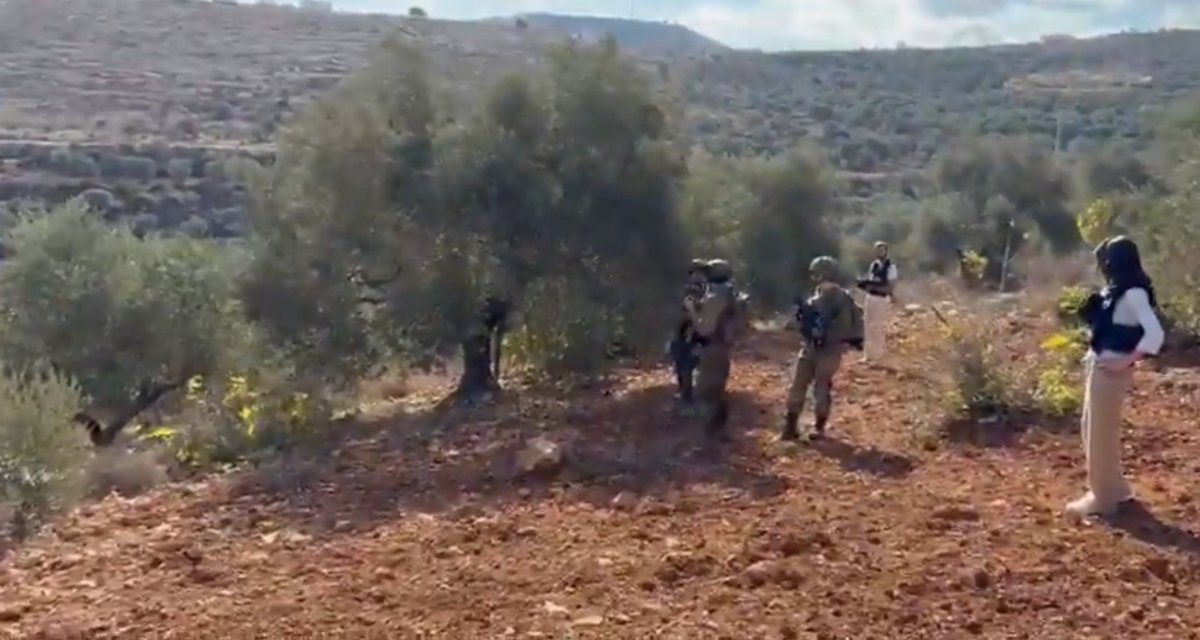
Alors que la saison des récoltes d’olives vient de débuter, les Palestiniens subissent déjà de nombreuses attaques de terreur coloniale.
Les colons israéliens profitent des restrictions de circulation imposées aux Palestiniens par l’armée israélienne pour se rendre eux-mêmes dans les champs et voler les olives appartenant aux agriculteurs palestiniens.
Comme ici à Qusra, gouvernorat de Naplouse :
Israeli settlers steal olives from Palestinian farmland north of Qusra, south of Nablus, in the occupied West Bank, after blocking Palestinian owners from reaching their land due to Israeli military restrictions during the olive harvest season. https://t.co/NtcfbPj0Lc
— Quds News Network (@QudsNen) October 5, 2026
Ou bien à Awarta :
Another day, another olive theft by settlers.
Today it was in Awarta, Nablus. https://t.co/PIvtCueSAH— Unarmed Civilian Protection in Palestine (@ucpinpalestine) October 4, 2026
Les soldats israéliens agissent souvent en collaboration avec les colons. Sur les terres agricoles du village de Beita, à Jabal al-Arma, les soldats ont tiré du gaz lacrymogène sur les fermiers palestiniens en pleine récolte d’olives sur leurs propres terres, permettant ainsi aux colons de s’emparer des olives.
How do you know the olive harvest season has begun ? It’s easy ! Settlers steal the crop, while the army—acting as a vanguard—prevents Palestinians from harvesting.
Jabal al-Arma, on the lands of the village of Beita : Soldiers fired tear gas at the harvesters. Live fire was also heard coming from the direction of the outpost.
— מסתכלים לכיבוש בעיניים (@Mistaclim) October 2, 2026
La même scène s’est déroulée à al-Mughayyir le 1er octobre : les soldats montent la garde pendant que les colons vandalisent les oliviers et volent les olives.
Theft under the protection of the military :
This morning, settlers vandalized olive trees belonging to residents of Al-Mughayyir and stole olives under the protection of Israeli soldiers who were guarding them. https://t.co/aDGFA16jBT— Yesh Din ييش دين יש דין (@Yesh_Din) October 1, 2026
La saison des récoltes d’olives, traditionnellement un moment convivial dans la culture palestinienne, est devenue de plus en plus dangereuse avec le temps, et surtout depuis le 8 octobre. Selon la commission de résistance au mur et à la colonisation, le mois d’octobre 2025 seul comptabilise autant d’attaques contre la récolte d’olives qu’une année entière avant le 8 octobre.
13 Palestiniens ont été blessés par les colons israéliens au cours du week-end du 3 octobre. Ils ont attaqué au moins 6 communautés palestiniennes et des dizaines d’oliviers ont été brûlés.
At least 13 Palestinians were wounded by settler terrorists over the weekend. Dozens of trees were set on fire, and at least six communities were attacked. This is how the olive harvest season began in the West Bank.
For tens of thousands of Palestinian families, it provides a major source of income. And for that very reason, the harvest is heavily targeted by settler terrorists and the IDF. During last year’s harvest, the UN recorded the highest monthly number of settler attacks since it began tracking.
In many areas of the West Bank, mostly near settlements, Palestinians are forced to obtain an IDF permit to reach their groves. The IDF often severely restricts access or denies it outright. Where permits aren’t required, settlers attack harvesters, and the IDF then comes in to back them up.
Beita :
Settlers attacked harvesters near the village. Instead of detaining the attackers, the IDF forced Palestinians and solidarity activists to leave.
Burin :
Settlers attacked villagers and stole their equipment ; the IDF then arrived and fired tear gas at Palestinians, injuring at least two.
Even without settler initiative, the IDF itself has uprooted thousands of olive trees since October 2023. Last year, the IDF uprooted more than 3,100 olive trees in al-Mughayyir alone, which Maj. Gen. Avi Bluth, the officer responsible for the entire West Bank, explicitly framed as collective punishment.
Attacks on the olive harvest are part of Israel’s broader policies of ethnic cleansing and annexation in the West Bank. Through terror and destroyed livelihoods, Palestinians are forced off their land. Since October 2023, over 4,700 Palestinians, roughly half of them children, have been displaced.
— Breaking the Silence (@BtSIsrael) October 4, 2026
Les attaques contre les champs d’oliviers n’ont pas lieu qu’au moment des récoltes : Beita, Jénine, al-Mughayyir, partout en Cisjordanie, les colons et l’armée brûlent ou déracinent des milliers d’arbres durant toute l’année.
Ces attaques ont lieu tous les ans. Elles sont inscrites dans la politique d’Israël d’annexion lente de la Cisjordanie : en harcelant les Palestiniens quotidiennement par des attaques de terreurs commises par les colons et en s’attaquant à leurs moyens de subsistance traditionnels tels que la culture des oliviers, Israël compte procéder au nettoyage ethnique du territoire puis l’annexer de facto.
Sources : Mistaclim / Quds News Network / Breaking the Silence / Yesh Din / Le Monde
Photo : capture d’écran © Breaking the Silence